A Weekly Update from the Red River Farm Network
Thursday, October 23, 2025

Drinking Out of a Fire Hose-If it feels like the ag headlines are changing by the hour, you’re right. From the chaos in trade relations with China and its impact on soybeans to potential White House involvement in the beef market to harvest updates and shifting weather patterns, there’s plenty for farmers to keep an eye on this week. The Red River Farm Network is here to break through the noise and provide timely and accurate information for farmers and ranchers. As always, we value your feedback. Send an email to don@rrfn.com and let us know where we can improve. If this newsletter is valuable for your business or organization, we’d love to hear that too.

Trump Threatens, Than Softens Trade Stance with China – The U.S.-Chinese trade relationship took many twists and turns this past week. Early in the week, President Trump addressed the trade relationship with China in a White House news briefing. “Look, I have a great relationship with President Xi, but sometimes he gets testy because China likes to take advantage of people,” said Trump. “We have a fair relationship with China, and I think it’ll be fine, and if it’s not, that’s okay too.” Beginning November 1, Trump threatened to impose 100 percent tariffs on Chinese imports in retaliation for new Chinese restrictions on rare earth minerals. By Friday, Trump said China forced him to take the aggressive stance and the 100 percent tariff rate was “not sustainable” for either country. Before trade talks can resume with China, Trump has a list of demands; China must take action on rare earth minerals, fentanyl and soybeans. Trump told reporters he believes a deal can still be made with China, but he wants to make sure their purchases amount to what they’ve bought before. Trump did indicate he would meet with Chinese President Xi at the Asia-Pacific Economic Cooperation summit at the end of this month.
Used Chinese Cooking Oil in the Crosshairs – President Donald Trump used Truth Social to deliver his latest warning to China. Trump said he believes China is purposely not buying U.S. soybeans, describing it as “an economically hostile act.’ Trump went on to say that the U.S. may terminate any business with China involving cooking oil and other aspects of trade as a form of retribution. Last year, the United States purchased nearly 1.3 million metric tons of used cooking oil from China. The imported cooking oil competes with domestic supplies in the renewable diesel and sustainable aviation fuel markets.

Cooking Oil Decision Could Have Huge Domino Effect – President Trump’s social media post suggesting a boycott on Chinese cooking oil has major implications for the U.S. soybean industry. However, Minnesota Soybean Growers Association Executive Director Joe Smentek says it’s biofuels policy issue, not a trade issue. “What has been happening is China and some of these other countries either are saying something is used cooking oil when it’s palm oil, Argentinian soybean oil, or whole South American soybeans going over to China, getting crushed, and China is sending us back the oil,” said Smentek. ” In a lot of cases, it is barely used cooking oil and it’s about capturing these credits in California under their low-carbon fuel standards.” The recent change to the 45Z tax credit includes a slight penalty for imported feedstocks. Smentek emphasized that domestic soy oil, which is a byproduct of the soybean crush, should receive the lowest carbon score. “Something like used cooking oil could impact the farm economy in such a myriad of ways, it really shows how complicated this really is for our farmers with one little decision that seemingly wouldn’t affect farm policy can have a huge domino effect.”
ASA Calls to Restore China Market Access – U.S. soybean farmers are urging President Trump’s Administration to turn trade and biofuel promises into action. The American Soybean Association says ongoing trade negotiations must restore access to the Chinese market, especially as harvest continues. The ASA is also calling on the EPA to finalize higher renewable fuel blending requirements for 2026 and 2027 and to reallocate small refinery exemptions to larger refineries. The group says these steps are critical to supporting biofuel production using U.S. soybean oil.
Chinese Soybean Imports Jump 13 Percent in September – Chinese soybean imports surged in September, climbing more than 13 percent year over year as overall imports rose sharply. Bank of America Global Research says imports from Brazil were up 24 percent, while purchases from the U.S. fell more than 16 percent, matching August’s decline. Total imports into China increased 7.4 percent, narrowing the trade surplus with the U.S. from $102.3 billion to $90.5 billion. Analysts say the data show continued resilience in China’s exports, supported by stable demand outside the U.S.
China Waits to Fill Dec-Jan Soybean Needs – China still needs to purchase 8-9 million tons of soybeans for December-January shipment. Those purchases are on hold for two reasons. They are avoiding the U.S. market because of the trade war. Price is the headache for South American soybeans. Brazilian soybeans are holding a $2.80-to$2.90 per bushel premium over November futures in Chicago.
U.S. Agricultural Trade Deficit Widens – The agricultural trade deficit is expected to worsen in the years ahead. A new study from the University of Illinois and Texas Tech University shows the U.S. is importing far more than it exports. Researchers say the decline began after the 2017–2018 trade dispute with China, which caused U.S. export values to drop by $14 billion. In that year, soybean exports fell 73 percent, while wheat, corn, and sorghum also saw steep declines. The U.S. continues to lose market share to competitors like Brazil, Canada, Australia, and Ukraine, though new trade agreements could help offset some of those losses.
MN Corn Matters – Adam Birr, CEO, Minnesota Corn Growers Association, was part of a U.S. Grains Council Grains trade delegation that traveled north of the border. Ninety-nine percent of Minnesota’s ethanol exports go to Canada. Click here to listen to the report.
Fischbach Welcomes Shift in Trade Policy – Minnesota Congresswoman Michelle Fischbach is a member of the House Ways and Means trade subcommittee. When asked about the current trade strategy, Fischbach said President Trump is bringing people to the table. “I will say this, at least they are doing something,” said Fischbach. “For four years, we didn’t have anything happening. We had (U.S. Trade Representative Katherine) Tai in front of our committee and she said they were not working on any free trade agreements; now, we’re moving on something.”
U.S.-Brazil Discuss Trade – U.S. Trade Ambassador Jamieson Greer and Secretary of State Marco Rubio met with the Brazilian foreign affairs ministry on Thursday to discuss trade. Brazil is currently dealing with 50 percent tariffs from the U.S. A meeting between President Trump and Brazilian President Lula is now being planned.
CONAB Forecasts Record Soybean Output for 2026 – Brazil’s crop agency, CONAB, estimates the 2025-26 corn crop at 138.6 million metric tons, slightly below its previous estimate but above USDA’s 131-million-ton forecast. The agency also projects a 16 percent jump in corn exports from last year, which could create additional competition for U.S. exports. CONAB expects Brazil to harvest another record soybean crop in 2026 at 177.6 million metric tons, up from 171.5 million in 2025. Soybean exports are also forecast to rise to 112 million metric tons next year as Brazil benefits from high production and reduced U.S. competition in the Chinese market.

White House Has Plan to Reduce Consumer Beef Prices – In the final minutes of a media briefing on Thursday, President Trump said energy and food prices are coming down. The one exception has been beef prices. “I think we have a deal on beef that would bring the price of beef (down); that would be the one product that we would say is a little bit higher than we’d want it, maybe higher than we want it,” said Trump. “That’s going to be coming down pretty soon. We worked our magic.” Trump more insight while talking with reporters on Air Force One on Sunday. “We would buy some beef from Argentina because if we do that it will bring our beef prices down.” Trump was asked about the impact on U.S. farmers. “Argentina is fighting for its life,” he said. “They’re fighting so hard to survive; if I can help them survive in a free world.”
NDSA Opposed to Any Market-Altering Policies – Cattle futures plummeted in reaction to President Trump’s comments on consumer beef prices. “While I don’t know the specifics of what the President has in mind and what it all means, the remarks were concerning,” said Julie Ellingson, executive vice president, North Dakota Stockmen’s Association. “Trump said an announcement would be made soon to address the cost of beef. North Dakota Stockmen’s Association Executive Vice President Julie Ellingson. “We’ve been steadfast against any market-altering type of policies. We really believe that consumers, not the government, should be those that set the market.” Just like other foods, supermarket prices for beef have risen. Yet, there is unprecedented demand for beef. “The U.S. consumer works 14 minutes on average to buy a pound of beef; that number has really held steady for decades.” RaboResearch has found that the number of minutes is below the peak levels that date back to the 1980s; beef prices have not risen any faster than the improvement in overall hourly wages.”
Cattle Groups React to Trump Comments – President Trump’s comments about high consumer beef prices and possible purchases of Argentine beef has the attention of major cattle groups. U.S. Cattlemen’s Association President Justin Topper stressed the importance of market-driven prices, not mandates or panic interventions. R-CALF USA CEO Bill Bullard is encouraging the government to address fundamental problems in the beef market, not its symptoms. Bullard said ‘attempting to lower domestic beef prices simply by inviting even more imports will both exacerbate and accelerate the ongoing dismantling of the domestic beef supply.’ The Red River Farm Network reached out to the National Cattlemen’s Association on Friday. An NCBA official said they didn’t have much information on what Trump meant by his comments, and they would make a statement once more details are known.

Market Drops Following Trump Comments – The Thursday comments made by the President, saying he had a deal on beef that would bring prices down, sent the cattle futures south on Friday. “Once again, President Trump is making comments impacting the markets,” said Arlan Suderman, chief commodities economist, StoneX. Cattle futures were trading at all-time highs, but that changed after Trump made those comments. “The speculative traders who hold large long positions in this market, at least we believe that to be the case, we don’t know for sure with the government shutdown and no weekly CFTC report,” said Suderman. “They got nervous when they saw that comment and they started selling off, taking feeder cattle down the $9.25 limit and live cattle have been down more than $6.”
Government Shutdown Continues – The government shutdown in Washington shows little hope for a resolution. Policy Solutions President Jay Truitt says lawmakers are waiting for key events before taking further action. “Democrats are waiting to take any steps until after the No Kings protest on October 18th; I think that does give us some timeframe after that. I don’t think this thing drags on much more.” Until lawmakers find common ground, several critical priorities remain stalled, including the ag package.”We’re just at a standoff. While we may see the administration try to do something creative, honestly, that really almost never works out the way we think it’s going to.”
Farm Aid Package Planned Once Government Reopens – Once the government reopens, Agriculture Secretary Brooke Rollins said a farm assistance package will be created, using tariff revenues to compensate farmers. She said it is also important to eventually move away from the hamster wheel of farm bailout programs. “They don’t want these checks, they want to be able to sell their products,” said Rollins. “Every time I travel around the country, this is what I’m hearing.”
Thune: Begin Marketing Loan Process – Senate Majority Leader John Thune is asking the White House to allow farmers to use marketing assistance loans so they can meet current cash flow needs. That would require USDA to reopen FSA offices, which seems unlikely until the government shutdown ends.
NASCOE Weighs in on FSA Staffing – The National Association of FSA County Office Employees is urging USDA to maintain adequate staffing at the county level. The current reorganization plan does not directly impact county offices, the group said the continued erosion of staffing capacity is a threat to FSA’s ability to meet its mission.

U.S. Farmers to Plant More Soybeans in 2026 – U.S. farmers are expected to shift more acres to soybeans next year while cutting back on corn and wheat. S&P Global Commodity Insights projects 2026 corn plantings at 96 million acres, soybeans at 83 million acres, and total wheat at 44.4 million acres. That would mean corn acreage drops by 2.7 million acres and wheat by just under one million, while soybeans increase by nearly two million acres compared to 2025.
La Niña to Bring Cooler, Wetter Winter – The National Weather Service says La Niña conditions have developed and are expected to persist through the winter, bringing cooler and wetter weather to the region. Below-average temperatures are forecast for Montana, North Dakota, and northern Minnesota, along with above-average precipitation across the Northern Plains.

Pioneer Agronomy Update – In the Pioneer Agronomy Update, Field Agronomist Kevin Sinner says attention will soon shift to crop evaluation for 2025. The Granular app can scrutinize planting dates, fertility, fungicide treatments and more. Listen to this update to learn more about this unique tool.

Big Bushels in SW MN Despite Disease Pressure – For the most part, the soybean harvest has been put to bed in southwest Minnesota. Matt Widboom, who farms at Worthington, had an above-average crop with yields in the 60s and 70s or better. The average was brought down by areas with disease pressure. “We had a lot of white mold issues, charcoal stem rot and some anthracnose,” said Widboom. “There were pockets across the field that were very greenhouse; we wanted a lot of vegetation, you want plants to be tall and have good nodes and pod development. We even did fungicide, but it just was not enough to beat back the disease pressure.” Widboom estimates 60 percent of the corn has been harvested in southwest Minnesota and northwest Iowa. It’s been a dry, dusty harvest. “The water turned off, heat stayed consistent and our corn drydown was really rapid. There is a lot of 13 percent (moisture) corn being combined in southwest Minnesota.” Stalk strength remains good and yields are above average.
A Season Full of Challenges and Surprises – Wimbledon, North Dakota grower Mike Clemens says this year’s season has been full of challenges and surprises. The derecho that hit his farm in late June is one example. “Crops were totally destroyed and ripped up and replanted, and now we’re into the harvest mode,” said Clemens. “The replant stuff, I’m glad we did it because you definitely can see it in the field, much better stands that are out there and better yield.” Clemens added that more weather issues struck late in the season, including a hailstorm that damaged 200 acres just before harvest. “A storm popped up at three o’clock in the morning and just put a bunch of small hail out there and just shelled all the beans out. That was kind of disheartening.”
Pleased With Yields Despite Early Frost – Even with an early frost that took off a bit of the top end in the soybeans, Rugby, North Dakota farmer Steve Fritel says the overall yields were good. “We noticed the yield differences, but overall, I guess we’re pleased with the yields that we had.” Fritel says the weather this growing season was great for the crops. “We went through a dry time in June, and then July got some rain that really benefited the crops more than we anticipated.”
All Over the Board – Mark Filbrandt, who leads Bigg Dogg Ag at Felton, Minnesota, said the soybean yields have been all over the board. “We had too much water early and we really turned dry late,” said Filbrandt. “We definitely lost on that, plus, we had a nipping frost, taking any idea of 60-70 (bushel per acre) beans all the way down to 35-40 (bushels per acre).”
Wet Conditions Slow Harvest – Harvest progress has slowed in the Devils Lake region as wet weather continues to stall farmers. Rock and Roll Agronomy Owner Jason Hanson says soybeans remain the biggest concern, with many acres still unharvested. “I know guys that are done combining, but they have ten percent of their acres still out there that they can’t get to. It’s got to freeze hard or else you’re never going to get them. I’d say we’re two-thirds done, that’s on fields, but it’s not on acres.”

Sugarbeet Campaign Underway in the Southern Red River Valley – The Minn-Dak Farmers Cooperative sugarbeet plant is running around the clock. “So far, knock on wood, everything is running as it should,” said Executive Vice President Mike Metzger. “You know, we like to see our root temperatures 55 degrees or lower, and everything’s right in line with the parameters.” Metzger says the quality is a little lower than he’d like, but the region was impacted by cercospora root rot. Yields in the northern part of its trade area are the best this year. “Stuff is looking really good, it’s tough to find a yield below 30 tons. In the southern end of our growing area, down that Wheaton–Herman area, they were just plagued with rain, so much rain this year, they’re running in the mid to upper 20s.”
Beet Campaign Slowed by Heat, Rain Delays – Growers are pushing forward with the current sugarbeet campaign. “We’re not done yet, that’s for sure, we probably have another 25 percent of the crop left to go,” said Betaseed Sales Manager John Samdahl. “It’s been a battle between the heat shutdowns and now we’ve got the moisture on the ground so growers are fighting really hard.” The beet crop in the American Crystal Sugar Company region is expected to average in the 33 tons per acre area. “That’s pretty close to what they can take, which is ideal, right?” Samdahl just came off of Betaseed’s kickoff for the 2026 sales season and is excited about the varieties coming to market for the year ahead.
An Above Average Spud Crop – Grafton, North Dakota farmer Greg Campbell says it has been a great year for potatoes and other crops. “In the potato world, we finished harvesting potatoes end of last week. It was definitely an above-average crop.” Campbell says disease pressure was low this year and crop quality is good. He notes that while yields on wheat, soybeans, and potatoes were good, prices remain low. “Everything is in storage. Hopefully, we’re waiting for some price increases to offset.”
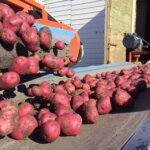
Warm Weather Slows Potato Harvest – Despite weather-related delays, Carl Hoverson, a farmer in the Larimore, North Dakota area, says the overall potato crop quality was good. “A lot of hot weather, so we had to wait a lot of days. Most days we worked this year were all half days. We started at four in the morning, and we usually worked till noon and stopped until the next day. It got to be a real long harvest.” Hoverson says it was a beautiful crop. “Because they’re in the ground longer, they all got a good size; we’re going to have a nice product to sell this winter.”
Dry Bean Harvest Nears Finish – Harvest is close to wrapping up for dry beans in northeast North Dakota, though wet conditions have slowed progress. Johnstown Bean Company General Manager Dylan Karley says farmers are still finishing the last few fields. “It’s been a slow kind of a walk to the finish line as opposed to a sprint. We’ve been fairly wet here for the past two and a half weeks, kind of ongoing so it’s been a bit sporadic trying to get the last five to ten percent in the bin.” Karley says recent rain and disease pressure trimmed yields in some fields, but overall quality has held up well.

Dry Bean Scene – In the Dry Bean Scene, Johnstown Bean Company General Manager Dylan Karley discusses the final acres, yields, and quality of dry beans. Click here to listen.
Kaiser: Phosphorus Pays Off Despite Higher Fertilizer Costs – As fall harvest progresses, farmers are planning out their fall fertilizer applications. University of Minnesota Associate Professor of Crops and Nutrient Management Dan Kaiser shared his recommendations for the Red River Valley. “There’s a fair amount of soils up there that are low in phosphorus,” said Kaiser. “Those are areas that we know that even with higher prices, as long as you’re not grossly over-applying, typically we get a positive return on investment.” Kaiser says farmers should be cautious about fertilizers with too many additives in them. “I think we’ll see some of these additives coming out of the woodwork, just trying to claim higher efficiency of it. I just have my doubts, especially for growers who are in situations that have high pH soils.”
Corn Leafhopper Detected Again in Minnesota – The corn leafhopper has been detected again in Minnesota, this time in a corn field in Waseca County. Adults were captured on yellow sticky traps in September during the late stages of corn development. The insect, which can transmit stunting diseases in corn, was first found in the state last year. Experts say there’s little risk to this year’s crop since detections occurred late in the season; however, warmer fall temperatures and more frequent southern winds could lead to earlier infestations in future years, potentially increasing the risk to late-planted corn.

SCN Losses Expected to Rise – Soybean Cyst Nematode is responsible for $1.5 billion in yield loss per year in the United States. University of Nebraska Extension Plant Pathologist Dylan Mangel, who is part of the SCN Coalition, expects those losses to only grow. Due to an overreliance on the PI 88788 source of resistance, SCN has found a way to overcome it. Mangel is now seeing more soybean varieties with the Peking source of resistance. “The problem with Peking is it’s more effective than PI 88788 ever was, which means it’s going to apply a stronger selection pressure on those nematodes; the data we have so far shows that it’s likely to break down a lot faster than the PI 88788 resistance source.” The Red River Farm Network asked Mangel if other potential sources of SCN resistance are in the pipeline. “The industry as a whole has just really struggled to get alternate resistance sources through to the end,” said Mangel. “We have some that look really good, but they just might not yield, for example. Ultimately, if they don’t yield, they’re not worthwhile to put out there.” In the meantime, the recommendation is to rotate between the two current resistance sources, Soil testing for soybean cyst nematode is also a priority.
A Silent Yield Robber – October is known as SCN Action Month. BASF Seed Treatment Product Manager Jeremiah Mullock sees the soybean cyst nematode as a silent yield robber. “In our BASF sampling the last few years, we’ve had over 6,000-plus samples and we’ve detected SCN in over 80 percent of those fields so really this problem is widespread and abundant,” said Mullock. “Often that yield loss is invisible; I think this is a great time for growers to take action and really proactively build a plan for the 2026 season that includes all the tools available to protect yield from SCN, Including native traits, crop rotations and a seed treatment like ILEVO that really adds that early season protection from those SCN juveniles.” The Soybean Cyst Nematode Coalition has a new SCN Profit Checker tool that can help farmers determine the economic impact of the pest in their soybeans. That tool is available online.
Harvest Pinched by Storage Losses – Grain storage took a hit in North Dakota following the June EF5 tornado. Losses were seen in commercial and on-farm storage. “Corn harvest is going to be crazy in this state because nobody has anywhere to dump it,” said Ryan Wanzek, who farms in North Dakota’s Stutsman County. “No one is going to have a place to go with it and it will be a long, drawn-out harvest the way it is looking to me.”
Storage Issues – Corn and soybean production are both expected to rise for the 2025-2026 marketing year. Limited growth in storage space could have ripple effects on prices. “Our big Cornbelt states have added very little new storage space in recent years,” said Bernt Nelson, economist, American Farm Bureau Federation. “The increase in crop with limited increase in demand or storage space could continue putting pressure on our crop prices. It also could have a big impact on basis”
Gold and Silver Prices in Lofty Territory – With trade tensions between the U.S. and China at a fever pitch, gold and silver prices are continuing to break record highs. “This does not mean interest rates are calming down.” In the AgBull podcast, commodity broker Tommy Grisafi says the rally in the precious metals keeps inflation in the conversation. However, “I think fuel and energy would way eclipse gold and silver; who uses gold or silver on a daily basis, but we use energy all the time.”
Powell Signals Fed Rate Cut Ahead – Federal Reserve Chair Jerome Powell signaled the central bank remains on course to cut interest rates later this month, citing weakness in the labor market despite lingering inflation concerns. Powell said the Fed is balancing two key risks—cutting rates too fast could leave inflation unresolved, while acting too slowly could trigger job losses. He also indicated the Fed may be nearing the end of its effort to shrink its $6.6 trillion asset portfolio, which was built up during the pandemic to support the economy. The Fed’s next policy meeting is set for October 28 and 29.
Easing Interest Rates Provide Some Help – According to a new report from the CoBank Knowledge Exchange, another four or five quarter-point interest rate cuts are expected through the end of next year. That would put the baseline interest rate around three percent at the end of 2026. That scenario is expected to provide relief for the ag sector. Fertilizer prices remain the biggest headwind for farmers. High crop input costs will also impact profitability.
What’s Hot, What’s Not in the Markets – In this week’s edition of What’s Hot, What’s Not in the Markets, Martinson Ag Risk Management President Randy Martinson looks to the outside markets with gold, silver and the stock market for strength. Cattle prices went the other direction late last week on comments made by President Trump. Click here.
Higher Crop Input Costs in ’26 – Farmers Business Network says crop protection pricing could rise in 2026 due to new tariffs and tighter supplies. The group’s annual market report highlights a shift from the lower prices seen in 2025 as inventories tighten and trade costs increase. FBN expects higher costs for products like glyphosate and glufosinate from China because of a 20 percent tariff, while other chemicals, such as 2,4-D could face combined duties exceeding 100 percent.
DNC Ads Target Farm Vote Ahead of Midterms – The Democratic National Committee is targeting 11 House districts now represented by Republicans for an ad campaign. According to Politico, the ads focus on the Trump Administration’s tariff strategy and the impact on soybean farmers. This is one of the DNC’s first major ad buys ahead of the midterm elections.
SD Corn Comments – In South Dakota Corn Comments, we learn about the potential for the opening of the biofuel industry in Mexico. DaNita Murray, executive director, South Dakota Corn, discusses this new demand. Click here to listen.
DOL Rule Eases H-2A Costs for Farmers – The Department of Labor’s updated rule for calculating H-2A wage rates is bringing relief to U.S. farmers after years of inflated labor costs. National Council of Agricultural Employers President and CEO Michael Marsh says the rule corrects decades of flawed data that disconnected wage rates from actual market conditions. “The Department of Labor decided to use the USDA’s farm labor survey, which was never designed for that purpose. As the program grew, the misuse of that data caused wage rates to spiral out of control and disconnected them from the marketplace.” Marsh says the new rule uses Bureau of Labor Statistics data to provide more realistic pay rates and significant savings for producers. “When you compare the new rates to what farmers had to pay previously for H-2A workers, it’s a substantial savings. The Department of Labor estimated that in just the first year of implementation, it should save farmers $2.4 billion. Over ten years, those savings will reach more than $17 billion. It’s a huge win for agricultural employers in the United States.”
Coalition Calls for “America First” Antitrust Action – R-CALF USA joined the Main Street Competition Coalition in calling on President Donald Trump to strengthen antitrust enforcement. The coalition’s letter—signed by the Independent Professional Seed Association, Minnesota Petroleum Marketers Association, North Dakota Corn Growers, North Dakota Petroleum Marketers, South Dakota Retailers, and hundreds of other independent businesses and organizations across 43 states—urged an “America First” focus on protecting open and fair markets. R-CALF CEO Bill Bullard said revitalizing competition in livestock markets is vital to rebuilding the nation’s cattle and sheep sectors, adding that firm enforcement of antitrust and fair competition laws is critical to achieving that goal.
Records Broken at Faith Livestock – This past week was the best ever for calf sales at Faith Livestock, with prices breaking all-time records. There was a sale of 131 head of 426-pound calves that brought $600. That’s the highest 4-weight sale for a lot of 50 head or more in U.S. history. That same day, over 90 head brought $493. That is the highest 6-weight sale on record nationwide.
Labor Seen as Dairy Industry’s Biggest Issue – According to National Milk Producers Federation Chairman Randy Mooney, labor is the #1 challenge for the dairy industry. “We’ve got the H-2A visas that don’t really fit dairy because they’re seasonal workers,” said Mooney. “We’ve got now the Trump Administration closing the border and the ICE raids that we’re seeing around the country and I’m not speaking against any of that, but what we need as a U.S. dairy industry is we need some clear immigration policies.” Mooney, who is also chair of Dairy Farmers of America, will step down from his NMPF leadership role next month. In the Dairy Defined podcast, Mooney said it has been an honor to lead National Milk for the past 17 years. “I’m not leaving because I’m getting out of the industry; I’m going to stay as chairman of DFA, but it’s time for somebody different and somebody younger and new ideas.”
Top 50 Dairy Co-op List Updated – Dairy Farmers of America remains the largest dairy cooperative nationwide. Milk volume totaled 55.7 billion pounds, down 6 million pounds from 2024. According to the Hoard’s Dairyman list of the top 50 dairy co-ops, Edge Dairy Farm Cooperative moved up to the #2 spot. Edge Dairy has members in nine states, including Minnesota and South Dakota. Midwest co-ops on the list include Land O’Lakes at #4, FarmFirst Dairy Cooperative at #7, Foremost Farms USDA at #8 and Associated Milk Producers, Inc. at #10.
American Lamb Board Opens $350K Research Funding – The American Lamb Board is offering $350,000 in research funding for fiscal year 2026 to support projects that strengthen the U.S. lamb industry. Proposals are being sought for initiatives that expand domestic sheep production and improve the quality and marketability of American Lamb. Projects may focus on areas like parasite control, genetics, grazing expansion, animal health, and product development. Summary proposals are due November 15, with final funding decisions expected in early 2026.

October is Co-op Month – October is National Co-op Month and this is the International Year of Cooperatives. Member-owned farm cooperatives create local jobs and improve food security. Two million U.S. farmers are members of more than 2,100 ag and retail purchasing cooperatives. These co-ops reinvest in their community. During National Co-op Month, Associated Milk Producers Incorporated and its Dinner Bell Creamery, the North Dakota Farmers Union and the Red River Farm Network recognize the role cooperatives play in our lives. Remember, cooperatives build a better world!
Farming for the Future – The Minnesota Department of Agriculture is partnering with the Red River Farm Network and the Linder Farm Network to provide information on soil health events and topics. This week, Warren Formo, Director of the Minnesota Agricultural Water Resource Coalition, talks about the work that they’re doing. Listen to the report.
Tractor Sales Rise in September – The Association of Equipment Manufacturers reports U.S. tractor sales rose four percent in September compared to a year ago, totaling 17,729 units. Smaller two-wheel-drive tractors under 100 horsepower saw gains, while larger models declined sharply. Combine sales dropped 22 percent for the month, with just 414 units sold. Through the first nine months of 2025, tractor sales are down eight percent overall, and combine sales are down 40 percent from the same period last year.

Perdue Emphasizes Strong Voice and New Opportunities – After 12 years on the job, North Dakota Farmers Union President Mark Watne is not seeking reelection. Two candidates are vying for the position: Matt Perdue and Shelly Ziesch. Perdue resigned from his role as NDFU government relations director in June to pursue the presidency. “The organization is in an incredibly strong position, great financial resources, incredibly strong membership, but there are a lot of challenges facing farmers and ranchers right now with trade, low commodity prices and high input costs.” Perdue describes himself as a strong voice that can represent NDFU in Washington, D.C. and Bismarck. In addition to his experience at the state level, Perdue also spent time on the National Farmers Union staff. He was raised on a family farm at Ray. In addition to the presidency, Perdue emphasized that this position is also the organization’s CEO. “We’re blessed with a lot of financial drivers; we have the restaurants, we have Farmers Union Insurance, we have Farmers Union Industries,” said Perdue. “We have a long history of entrepreneurship and my priorities are to ensure that those entities remain strong while leveraging them to create new opportunities for our members.”

Ziesch: ‘It’s Important to Have an Active Farmer in that Role’ – Shelly Ziesch is a fourth-generation farmer and rancher at Pettibone. After seven years on the South Dakota Farmers Union board, she is making a run for president. “I just think it is really important to have an active farmer or rancher in that role,” said Ziesch. “Chances are if you’re going through a certain situation, I’ve also been through it as some point in my career.” Ziesch said she has been through the ups and downs in the market, and trying to rent or buy farmland as a young producer. Ziesch wants to speak up for the farmers of today and tomorrow. “We’ve already lost a lot of farmers and ranchers due to low prices in the past and we can’t continue down that road or it will completely obliterate everyone out in the rural area.” Delegates will vote during the North Dakota Farmers Union Convention in mid-December.
FFA Earns Significant Grant – The National FFA Organization is one of six national groups to receive a $10 million grant from the Lily Endowment and its Character Development Through Youth Program. A foundation spokesperson said FFA has a long history of supporting young people and helping them to grow into strong adults. FFA takes center stage later this month with its national convention in Indianapolis.

SDFU Donates 35,000 Pounds of Pork to Feeding South Dakota – The South Dakota Farmers Union has delivered a significant pork donation to Feeding South Dakota. “Farmers Union Enterprises, which is comprised of five state Farmers Unions; Montana, North Dakota, South Dakota, Minnesota and Wisconsin, has donated 175,000 of hams to their respective states,” said South Dakota Farmers Union Executive Director Karla Hofhenke. “Our share was 35,000 pounds or about 2,000 hams that were delivered.” Hofhenke said farmers recognize the impact of high food costs and believe in giving back to their communities.
Canola Minute – In the Canola Minute, Northern Canola Growers Association Executive Director, Barry Coleman, invites everyone to the annual meeting in Minot November 5-6. Click here to listen.
GEVO Loan Guarantee Extended – The Trump administration is extending a $1.46 billion loan guarantee to Gevo, a company producing sustainable aviation fuel from corn ethanol. Gevo is considering moving the guarantee from its Lake Preston, South Dakota plant to the Richardton, North Dakota facility acquired earlier this year, due in part to delays with a carbon dioxide pipeline in South Dakota. The shift would reduce the size of the loan guarantee, and the extension to April 2026 allows time to adjust the project to align with administration energy policies.
New SDSU Wheat Released – South Dakota State University is releasing a new hard red winter wheat variety. SD Vivian demonstrates moderate to good resistance to drought, stem rust and Hessian fly. It is also described as a high-yielding variety with above-average protein. It will be available for purchase for planting this fall.
Ruehle Moves to Red Angus Association – The Red Angus Association has hired Greg Ruehle as its new executive vice president. Ruehle’s background includes executive leadership roles with the Nebraska Cattlemen, American Shorthorn Association, National Sorghum Producers and Independent Professional Seed Association.
New Hire, Promotions at Ten Acre Marketing – Brock Nemecek has joined Ten Acre Marketing as its new vice president of client services. Nemecek has spent time in consulting and with Farm Journal. Mary Heslep will move into the role of senior vice president of strategy and business development. Terri Spencer was promoted to senior vice president of operations and creative.

Last Week’s Trivia-Paul Stanley, Gene Simmons, Ace Frehley and Peter Criss were the original members of the classic rock band, KISS. Keith Rekow of Dairyland Seed wins our weekly trivia challenge. Runner-up honors belong to longtime livestock consultant Bruce Trautman, Jim Altringer of Dakota Plains Ag, Peter Carson of Carson Farms and Kevin Praska of Stone’s Moble Radio. The ‘first 20’ rounds out with Regan farmer Jim McCullough, Mark Haugland of the National Wheat Foundation, Mackenzie Adams of CHS Ag Services, Bottineau County farmer Larry Neubauer, Roger Potter of Potterosa Limousin, Randy Knudsvig of First State Bank, Danny Pinske of Bennett Houglum Agency, Keith Bjorneby of Lone Wolf Farms, Dave Gehrtz of Proseed, Karlstad farmer Justin Dagen, Strasburg farmer Kenny Niewsma, Val Dolcini of Syngenta, Barry Walton of BW Farms, Ramsey County farmer Paul Becker and Ron Dvergsten of Northland Farm Business Management.
This Week’s Trivia- What does the term B2B mean? Send your answer to don@rrfn.com.
| Contact RRFN | Don Wick (701) 795-1315 |
Jamie Dickerman (701)-795-1315 |
Kloe Wadd (701)-795-1315 |
| RRFN Affiliate Stations | |||
| Aberdeen, SD – 105.5 FM | Ada, MN – 106.5 FM | Bagley, MN – 96.7 FM | Bemidji, MN – 1300 AM |
| Bismarck, ND – 1270 AM | Casselton, ND – 103.9 FM | Cavalier, ND – 105.1 FM | Crookston, MN – 1260 AM |
| Devils Lake, ND – 103.5 FM | Fergus Falls, MN – 1250 AM | Fosston, MN – 1480 AM | Glenwood, MN – 107.1 FM |
| Grafton, ND – 1340 AM | Jamestown, ND – 600 AM | Langdon, ND – 1080 AM | Mahnomen, MN – 101.5 FM |
| Mayville, ND – 105.5 FM | Roseau, MN – 102.1 FM | Rugby, ND – 1450 AM | Thief River Falls, MN – 1460 AM |
| Wadena, MN – 920 AM | Warroad, MN – 92.5 FM | Worthington, MN – 730 AM | |
FarmNetNews is a production of the Red River Farm Network. RRFN is based in Grand Forks, North Dakota and provides news to farmers and ranchers across Minnesota, North Dakota and South Dakota.